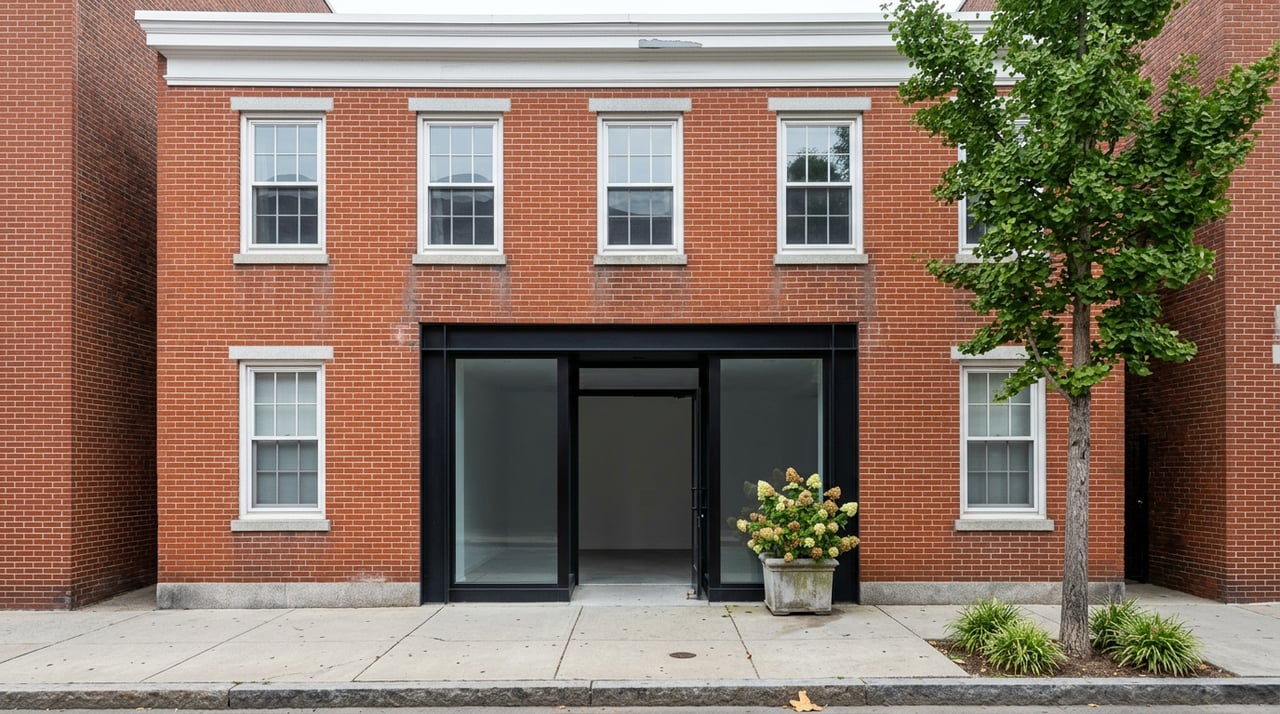
Walk down Mass Ave through Central Square this month, from Bishop Allen Drive to Lafayette Square, and you'll pass three businesses that look nothing like they used to. None of them required a permit for new construction. No cranes, no scaffolding, no ground broken. Central Square's busiest stretch in years is happening entirely inside buildings that were already standing.
That's the part of the story most passersby miss. The square looks the same from the sidewalk. What's changed is what's happening inside the same four walls, and in one case, inside a building that's been standing since 1870.
The restaurant that tripled without moving very far
Moona spent nine years in a 30-seat space in Inman Square before its owner, Mohamad El Zein, decided the concept had outgrown the room. Rather than expand in place, Moona relocated about a mile away to 750 Main St in Central Square, a space large enough to add an entirely new all-day operation the original location never had room for: a café called Sawa by day and a lounge called Sahra by night, alongside the dinner service the restaurant was already known for. Dinner reservations opened on December 30, with the café side following in February and March, according to Boston Magazine's coverage of the move.
El Zein brought on pastry chef Giselle Miller, a James Beard Award semifinalist with a résumé that includes Menton and Deuxave, to run the new all-day program. He's described the challenge of the larger footprint in terms of scale, not ambition: the goal was to "maintain that intimacy" of the original room even after tripling its size.
That's worth sitting with. Central Square didn't attract Moona with incentives or a splashy new development. It attracted Moona because it had an existing commercial space large enough to hold a concept that had already proven itself somewhere else in Cambridge. The square functioned as capacity, not as a blank canvas.
Same address, new life
A few blocks over, the pattern runs in the opposite direction. The space long occupied by Mary Chung's, a Central Square fixture for decades, is now home to Darlings, a Chinese-inspired cocktail bar. Rather than gut the space or relocate the concept elsewhere, the new operators kept the address and built something new inside it: a daily-changing cocktail menu paired with reimagined dim sum, open Tuesday through Sunday evenings, according to the Central Square Business Improvement District's business directory.
This is a different mechanism than Moona's move, but it points to the same underlying fact. When a long-running Central Square business closes, the next tenant isn't waiting for a teardown. They're waiting for the keys.
A building well over a century old, doing three jobs at once
The clearest example of this pattern predates both of the restaurant stories above, but it's still shaping how the square functions today. The building at Lafayette Square, originally constructed in 1870 as the Whitney, Lucretia and Henry Building, spent decades as commercial space, then apartments, then offices, before being restored into a 67-key boutique hotel, LEED-certified and listed as a contributing structure in the Central Square Historic District on the National Register of Historic Places. Today it operates as a hotel with two on-site food and beverage venues built into the original brick and window bays, a single historic structure now doing the work of a hotel, a restaurant, and a bar.
The construction team behind its restoration has pointed to the project as proof that tight, zero-lot-line urban sites in Cambridge don't need to be cleared to be reused. That's not a marketing line. It's a description of what actually happened on that corner, and it's the same logic playing out one block away at Moona's new space and two blocks away at Darlings.
What this actually looks like if you live here
None of this shows up as a construction notice or a zoning hearing. It shows up as a slightly different weekly rhythm for anyone who already treats Central Square as home base. Here's what's actually on the calendar right now, as of mid-August 2026:
- Central Square Farmers Market, every Monday through November 23, on Norfolk Street between Mass Ave and Bishop Allen Drive, right near H-Mart and Graffiti Alley. Over two dozen Massachusetts farmers and food producers, run by Mass Farmers Markets with support from the Central Square BID.
- Dine Out Boston, running through August 15, with participating Central Square restaurants offering prix fixe lunch and dinner menus for the final stretch of the citywide program.
- Central Square Night Market, Saturday, September 20, from 5 to 10 p.m. at University Park on Sidney Street. Food trucks, a beer garden, live performances, and free admission, organized by the Central Square BID in partnership with the Boston Night Market team.
None of these events required a new building either. The farmers market runs on a public street that's hosted it for years. The night market takes over a plaza that already exists. Dine Out Boston works because the restaurants were already there, ready to put a different menu on the table for two weeks.
Why this matters more than a new building would
It's tempting to measure a neighborhood's momentum by counting permits and cranes. Central Square's summer suggests a better measure: how much existing square footage is finding a second use. A restaurant that outgrows a 30-seat room and finds a bigger one nearby. A closed institution that hands its address to something new instead of sitting vacant. A brownstone built in 1870 that's been a shop, then apartments, then offices, then a hotel with two working kitchens, all without changing its footprint on Lafayette Square.
That's a different kind of growth than the kind that shows up in a construction pipeline report. It's slower to notice, and it depends on a very specific condition: a square with enough existing building stock, and few enough vacant lots, that reuse becomes the default answer rather than the exception. Central Square has spent decades accumulating exactly that kind of stock, from the confectionery-era buildings along Mass Ave to the mixed-use blocks near Bishop Allen Drive. Right now, that inventory is paying off in restaurant seats and market stalls rather than sitting quiet.
If you've lived here for a while, you've probably felt this without naming it. The square feels busier on a Monday evening than it used to, and now you know part of the reason: there's a farmers market running on a street that didn't always host one, a restaurant three times its old size two blocks from where it used to sit, and a cocktail bar pouring drinks in a room that used to serve dumplings under a different name. None of it required tearing anything down. It just required someone deciding the building was already good enough to work with.
That's the version of Central Square worth knowing this August, whether you're heading to the Monday market on Norfolk Street, grabbing a Dine Out Boston prix fixe before the window closes, or putting September 20 on the calendar for the Night Market at University Park.
If you're curious how this kind of neighborhood-level change eventually shows up in home values and building conditions around Central Square, that's exactly the kind of question our team spends its time on. Talk to the Lauren Holleran team whenever you're ready to dig into what's happening on your own block.